Showing posts with label Richard Dawkins. Show all posts

Tuesday, 27 August 2013

Is Tarek Fatah a "Secular Muslim" or an "Ex-Muslim Secularist"?


Do Canadians ever wonder why Canadian Muslims are so averse to Tarek Fatah's thinly veiled diatribes against Islam? Is the Muslim Canadian Congress (MCC) really a group devoted to protecting the social fabric of Canada against the non-existent threat of "Islamism"? The answer to these questions are not difficult and really require one to simply look at the evidence. Tarek Fatah claims to be a Muslim, all the while being a secularist, despite showing lucid contempt for Islam. As one tweeter recently noted on the 24th of August, 2013:


Tweeter Doug Janack does make a good point "I don't think I've read a single thing by you that doesn't support Dawkins' sneering contempt for Islam." It's not a difficult statement for a Muslim to understand because all Tarek Fatah has done in the last decade is demean and vilify the vast Canadian Muslim public (let alone Islam) while pretending to be an expert on Islam. On the same day which the above tweet was taken, Tarek Fatah displayed some of his anti-Islamic bigotry. In the first tweet a tweet by the name of O.J. rightfully claims that Tarek Fatah is not an authority on Islam. In response Tarek Fatah tweets back in his usual banal and derogatory language -- hardly fit for a so-called "real Muslim".  Tarek Fatah tweets "Yeah right, I'm just not ugly enough to be considered a real Muslim by Islamists in black shrink wraps." Firstly, Tarek Fatah alleges that like the majority of Muslims, he's not "ugly" enough, to be considered one, especially by scholars in "black shrink wraps". 


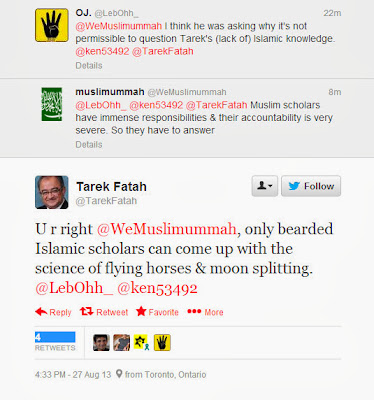
In another tweet Tarek Fatah alleges that only "bearded Islamic scholars can come up with with the science of flying horses and moon splitting". In this tweet Tarek Fatah's belief in Islam comes under attack as he employs sarcasm to mock 1) bearded men and the "science" of 2) flying horses, and 3) moon splitting -- all three ideas core to Islam. Firstly, it is incumbent on Muslim men to grow the beard. Secondly, the baraq* (not horse) upon which the Prophet Muhammad (PBUH) rode on into the 7 heavens is an essential belief in Islam. Thirdly, the miracle performed by the Prophet Muhammad (PBUH) in which he split the moon is mentioned in the Quran, Surah 55, The Moon, Verses 1-2. 


Whether Tarek Fatah is really a Muslim is up to the reader's discretion. One can only wonder how an alleged "Muslim" such as Tarek Fatah agrees with the following tweet by Richard Dawkins.


Muslims are honestly left speechless. What is Tarek Fatah really? A "secular Muslim" or an "ex-Muslim secularist"? It wouldn't be far-fetched to assert that Tarek Fatah is really an "ex-Muslim secularist" robbing people of their hard-earned money whilst pretending to be an authority on Islam.

More on Tarek Fatah:
  • For Tarek Fatah's errors in his book "Chasing A Mirage" click here

Friday, 23 August 2013

Historically Speaking, Muslims Were Never Opposed To Science

When religion and science are mentioned together one imagines opposing forces, systems of thought that are anathema of each other, there being no sign of reconciliation between the two. One classic historical example is Galileo's indictment by the Catholic Church for supporting the idea that Earth was not the center of the universe (and even stationary), an idea that verged on heresy and demanded immediate reprehension. However, upon researching Islam's history, one does not come across a situation where Islam and science were diametrically opposed to each other. In fact, classical Muslim orthodoxy adopted science as a tool in both realms of academia and daily life. In 1987, Islam studies specialist and historian A.I. Sabra submitted a ground-breaking paper that described the three stages in which Muslims adopted the scientific tradition. David C. Lindberg, author of The Beginnings of Western Science, informs the reader about the conclusion of Sabra's research:
"A. I. Sabra proposed three stages in the fortunes of the classical tradition in Islam. In the first stage, he argued, 'Greek science entered the world of Islam, not as an invading force...but as an invited guest'--a guest, moreover, whose Hellenistic worldview experienced 'an almost immediate and almost unreserved adoption...by Muslim members of the household.' In the second stage,the guest, now a comfortable member of the community, was the source and inspiration for remarkable scientific achievements by outstanding scholars, who accepted the fundamental assumptions of the classical tradition, took up its unresolved problems, and corrected, refined, and extended its conclusions. This was not the beginning of a new scientific tradition, as some have argued, but a continuation of the Greek classical tradition on Islamic soil and with an Islamic voice. Finally, by the time the third stage made its appearance, the pioneers of Hellenistic science had passed away, to be replaced by a generation of scholars, almost every one of whom 'had undergone a thorough Muslim education' and 'were imbued with Muslim learning and tradition.' The result was the integration of Greek disciplines with traditional learning and Islamic culture more generally. Thus logic became incorporated into theology and law; astronomy became an indispensable tool for the muwwaqqit, who was responsible for determining the times of daily prayer in his locale; and mathematics became essential for a wide variety of commercial, legal, and scientific purposes. In this stage, which Sabra calls 'naturalization', the classical tradition had become fully assimilated and put to use. The guest had become a member of the household in the role of handmaiden [1]."
This information is easily summarized in three succinct points:

1. Greek science entered Islamic world as an invited guest within the Muslim household.
2. As a member of the community, served as source of scientific inspiration & innovation.
3. The final result was that the guest had become a member of household as handmaiden.

Atheists, especially the bulldog of Atheism, Richard Dawkins, considers religiosity a brazen affront to empirical observation and rationale. The only problem with this thesis is that Muslims played a major role in shaping science for centuries to come before the torch was passed on to Europeans, who then further refined the ideals of science during the Renaissance. However, how much thought and consideration should medieval Muslims be given for the extent of their scientific achievements? David C. Lindberg writes,

"The scientific movement in Islam was distinguished and of long duration. Translation of Greek works into Arabic began in the second half of the eighth century; by end of the ninth century translation activity had crested, and serious scholarship was under way. From the middle of the ninth century until well into the fourteenth, we find impressive scientific work in major branches of Greek science, carried forward in widely scattered cities of the Islamic world. If we concentrate our attention on mathematics and astronomy, where many of Islam's greatest achievements lay, we find serious research by capable mathematicians and astronomers as late as the first half of the sixteenth century. This period of Islamic preeminence in the mathematical sciences lasted well over half a millennium -- a longer period than the interval between Copernicus and ourselves [2]."
Furthermore, the pioneer of the scientific method, the very intellectual bastion of empiricism, is none other than Ibn al-Haytham (ca. 965 - ca. 1039), a Muslim known for his outstanding accomplishments in the realm of mathematics and astronomy [3] [4]. This is a stark reminder to atheists who proudly contend that science is purely secular endeavor. 

Works Cited  

[1] Lindberg, D. C. (2007). Islamic Reception and Appropriation of Greek Science. The beginnings of western science: the European scientific tradition in philosophical, religious, and institutional context, prehistory to A.D. 1450 (2nd ed., p. 174). Chicago: University of Chicago Press.
[2] Ibid, pg. 189
[3] Ibid, pg. 179
[4] Heinen, A. M., & Biruni International Congress. (1973). Al-Biruni and ibn al-Haytham: A comparative study of scientific method. Pakistan.